
v2.2.0 - Consent-Aware Embeds, Configurable Controls, and More Integrations
Last updated August 24, 2026
c15t 2.2 expands consent-aware integrations beyond background scripts and into the parts of your product that people interact with. The release adds ready-to-use Google Maps and YouTube components, a configurable consent controls toolbar, eight new script providers, a reusable hook for custom SDK integrations, and improvements across consent storage, IAB TCF, theming, translations, and the self-hosted backend.
This is a minor release with no breaking changes.
Highlights
- New consent-aware
GoogleMapandYouTubeEmbedcomponents for React and Next.js - New opt-in
ConsentDialogTriggerToolbarfor combining privacy preferences with app-owned controls - New
useConsentScripthook for custom SDK-backed integrations - Eight new built-in providers: Adobe Analytics, Amplitude, Clearbit, Heap, Hightouch, LogRocket, Pirsch, and RudderStack
- RudderStack pre-consent buffering with category-to-consent-ID mapping
- Microsoft Clarity Consent V2 support and a corrected Mixpanel bootstrap
- PostHog initialization and pre-load event queue fixes
- Policy-aware primary action styling, including IAB consent surfaces
- New
nonceoption applying your CSP nonce to injected styles and scripts - Reliable offline IAB GVL loading and language refreshes
- Stronger consent submission deduplication and timestamp handling
- Hindi and Gujarati translations for the full consent experience
Consent-aware Google Maps and YouTube
The new renderable integrations handle both consent and the interface shown while third-party content is blocked or loading.
GoogleMap keeps the Google Maps JavaScript API off the page until the configured consent category is allowed. It shares one page-level loader across map instances, adopts an existing compatible Maps SDK, and provides accessible blocked, loading, and error states. Loader failures can be retried without creating duplicate Google Maps registrations.
YouTubeEmbed keeps the iframe unmounted until consent, so no YouTube request is made while the content is blocked. It defaults to the privacy-enhanced youtube-nocookie.com host, lazy loading, a responsive 16:9 frame, and type-safe options for video IDs, start times, and player parameters.
Both components are available from @c15t/react and @c15t/nextjs. Their loading and error messages use the active c15t translations and can be replaced with custom fallbacks.
→ Google Maps · YouTube
Build custom SDK integrations with useConsentScript
The new useConsentScript hook provides the lifecycle foundation used by GoogleMap. Use it when a third-party SDK needs more than a script element and your component must wait for a callback or global API before it can render.
The hook:
- registers the script through the consent manager
- shares compatible registrations within one provider
- exposes blocked, loading, ready, and error states
- resolves callback-based or global SDK readiness
- supports timeouts and explicit retries
- cleans up registrations according to the selected unmount behavior
This keeps custom widgets connected to the same consent and script lifecycle as c15t's built-in integrations.
→ React Script Loader · Next.js Script Loader
Configurable consent controls toolbar
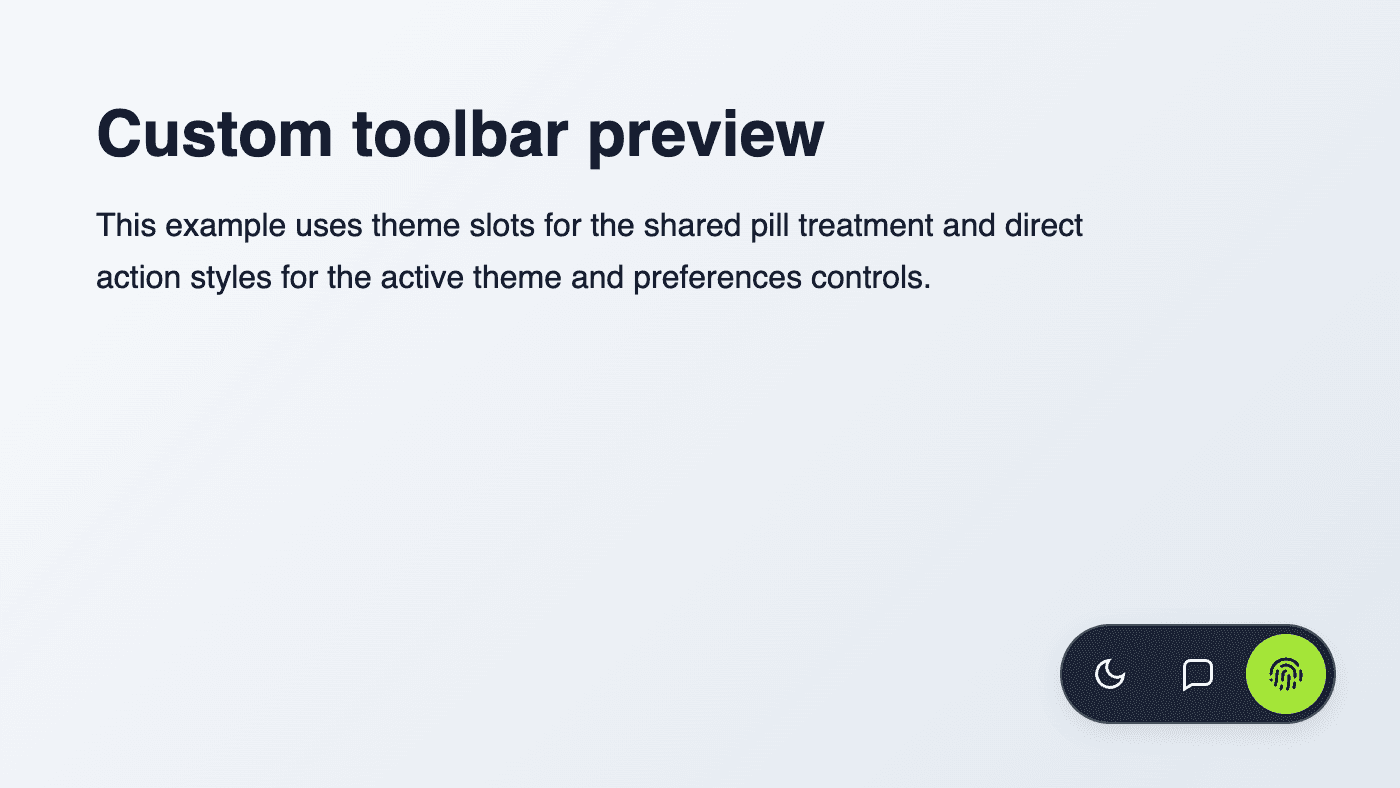
React and Next.js now include ConsentDialogTriggerToolbar, an opt-in alternative to the existing single-button ConsentDialogTrigger. It combines one built-in privacy preferences action with app-owned controls such as theme, accessibility, or support actions.
<ConsentDialogTriggerToolbar
  ariaLabel="Site controls"
  actions={[
    {
      id: 'theme',
      label: 'Dark color scheme',
      icon: isDark ? <SunIcon /> : <MoonIcon />,
      pressed: isDark,
      onSelect: toggleColorScheme,
    },
    {
      id: 'support',
      label: 'Open support chat',
      icon: <ChatIcon />,
      onSelect: openSupportChat,
    },
  ]}
  preferences={{
    icon: 'fingerprint',
    label: 'Manage privacy settings',
  }}
/>
The toolbar supports horizontal and vertical layouts, drag-to-corner positioning, keyboard navigation, disabled and pressed action states, theme slots, direct style overrides, and fully custom styling with noStyle. Your application owns custom action state and behavior, while c15t always provides exactly one action that opens consent preferences.
The existing ConsentDialogTrigger API and single-button behavior are unchanged, so adopting the toolbar does not require a migration.
→ React Consent Dialog Trigger · Next.js Consent Dialog Trigger
Eight new script integrations
@c15t/scripts adds eight built-in, registry-backed helpers, growing the provider registry from 28 to 36 integrations:
- Adobe Analytics — loads an Adobe Experience Platform Data Collection Tags embed behind measurement consent
- Amplitude — reproduces the Browser SDK 2 queue and synchronizes runtime opt-out state
- Clearbit — gates visitor and company enrichment on marketing consent
- Heap — implements the current heap.js callback queue contract
- Hightouch — queues the Events browser SDK with optional host and initial page tracking
- LogRocket — loads and initializes session replay after measurement consent
- Pirsch — preserves Pirsch's required script ID and identification-code attributes
- RudderStack — implements the v3 queue with validated write-key and data-plane configuration
Each provider includes registry metadata, framework examples, lifecycle guidance, and contract coverage against the vendor's current loader behavior.
RudderStack pre-consent mode
RudderStack still blocks its SDK until consent by default. 2.2 also adds an explicit pre-consent mode for teams that need to preserve event attribution before a decision is made.
With consentManagement.mapping, you can map c15t categories to RudderStack consent IDs. c15t then loads RudderStack in its inert pre-consent mode, disables storage, buffers delivery, and sends every consent decision through rudderanalytics.consent().
The default remains the stricter load gate. Pre-consent mode is opt-in because it should only be used when the mapped behavior matches your privacy policy.
Microsoft Clarity, Mixpanel, and PostHog fixes
The Microsoft Clarity helper now uses Consent V2. c15t maps marketing consent to ad_Storage and measurement consent to analytics_Storage, and defaultConsent accepts a Consent V2 payload.
The helper also no longer adds Clarity's v marker before the vendor runtime loads. Clarity treated that marker as a duplicate installation, raised CL001, and could silently collect no data.
The Mixpanel helper now implements the official snippet contract, including the __SV version marker and _i initialization registry. This prevents the SDK from reporting a version mismatch and dropping events queued before it finishes loading.
The PostHog helper now seeds the pending initialization tuple expected by current array.js releases. It also keeps posthog.capture(...) calls made before the SDK arrives in PostHog's root queue and applies the consent decision before those events replay. Existing installed SDK methods remain untouched if an after-consent integration loads again after consent is revoked and restored.
The core script loader also now preserves an explicit async: false, which is required by synchronous vendor embeds such as legacy Adobe Tags configurations.
→ Microsoft Clarity · Mixpanel · PostHog
Policy-aware primary action styling
Themes can now define consentActions.primary to style whichever action the active policy marks as primary. The policy continues to decide whether that action is accept, reject, or customize, while the theme controls how primary actions look.
Explicit component props and per-action theme keys still take precedence. The IAB consent banner now uses the same resolution rules instead of bypassing consentActions with hard-coded button variants.
Content Security Policy support
c15t injects a <style> element for your theme tokens and a <script> element for each consented vendor. Neither carried a nonce, so a nonce-based Content Security Policy blocked both — and because a directive that specifies a nonce ignores 'unsafe-inline', the only escape was to abandon nonces for that directive.
The provider now accepts a nonce and applies it to everything c15t injects:
<ConsentManagerProvider options={{ mode: 'offline', nonce }}>
  {children}
</ConsentManagerProvider>
A nonce set on an individual script definition still takes precedence, so you can override a single vendor without changing the provider.
This covers the elements c15t injects. Inline style attributes are governed by style-src-attr, a directive that ignores nonces entirely, so a policy that restricts it is unaffected by this option.
→ React ConsentManagerProvider · Next.js ConsentManagerProvider
IAB TCF reliability
IAB TCF now works correctly when c15t runs in offline mode or falls back from the hosted service. The IAB runtime receives the GVL fetcher directly, allowing the Global Vendor List to load so the banner can render.
GVL requests now use the resolved consent language, keeping vendor purposes and features aligned with the rest of the interface. Changing language or location overrides also carries the IAB configuration through re-initialization and refreshes the GVL instead of retaining stale content.
→ React IAB · Next.js IAB · Self-Hosted IAB
More reliable consent submissions
Concurrent saves with the same consent decision are now coalesced in the client and resolve to the same deterministic record in the backend. This prevents duplicate consent rows when identical requests arrive together while preserving idempotent retries across every supported database.
The backend also handles incorrect client clocks more safely. Timestamps more than five minutes in the future are clamped to server time for consent validity, while the original client value is retained in metadata and used to keep retries idempotent. The client then synchronizes its local consent state to the timestamp accepted by the server.
Legacy duplicate lookups are now scoped to the current tenant, and timestamps outside JavaScript's representable Date range are rejected before an ID is derived.
Backend, API, and compatibility improvements
- Browser, SSR, prefetch, and Node SDK requests now forward
x-c15t-version, and the backend allows it through CORS preflight handling. - Custom
headersconfigured for hosted clients are no longer dropped. They are included in the runtime cache key so differently configured clients cannot share an instance. - Explicit ports in
trustedOriginsare now matched exactly, while host-only entries remain port-agnostic. - Legal document types now accept suffixed variants such as
terms_and_conditions_b2b, allowing multiple policies from the same family. - Generated OpenAPI request schemas are more accurate for consent, subject, and legal-document endpoints.
@c15t/backendnow supportsdrizzle-orm0.45.x, Prisma 7, and MongoDB 7 through updated optional peer ranges.- A dependency and security audit updates core runtime dependencies, removes unused oRPC packages, and raises patched dependency floors. Published declaration types remain semantically unchanged after the move to TypeScript 7 and rslib 0.23.
Hindi, Gujarati, and translation fixes
Hindi (hi) and Gujarati (gu) are now available across cookie banners, consent dialogs, preference centers, and IAB TCF consent UI, bringing the translation catalog to 35 languages.
The second sentence of the IAB consent-storage notice is now translated in all 32 non-English locales instead of falling back to English. This release also fixes a stray German word in the Latvian custom-vendors notice.
Documentation and integration checks
Every new script and renderable integration has a dedicated guide with React and Next.js examples, lifecycle behavior, configuration, and verification steps. The docs also clarify consent subject identification and add 11 comparison guides for teams evaluating c15t alongside other consent tools.
Built-in script providers are now exercised by a daily live-vendor monitor, with additional checks that always-loaded providers do not send data while consent is denied. This helps catch upstream loader changes that static tests cannot see.
Thank you to our contributors
, , , , , , ,